
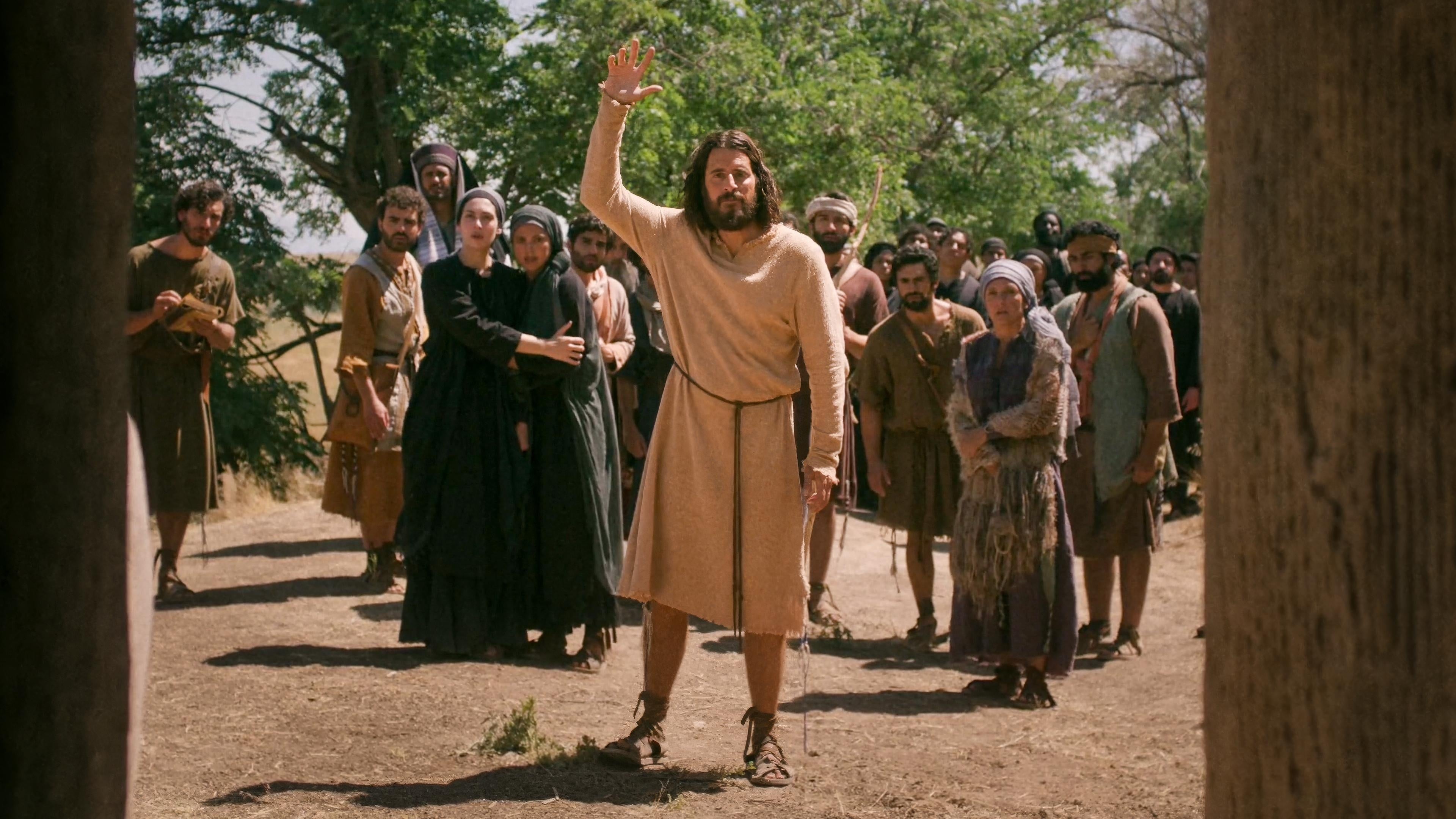
Summary of Episode 7
The episode opens with a glimpse into the future. An elderly Matthew visits Mary Magdalene, who lives in quiet isolation. He brings her the completed account of his Gospel and the news that Little James has been executed in Egypt. As they remember the past, Matthew learns that Mary has been writing personal reflections to process grief, fear, and recurring dreams.
The story then returns to the present. As Jesus and the disciples travel toward Bethany to mourn Lazarus, Little James grows visibly weaker. Along the way, he speaks with Mary Magdalene about death and his declining health. Mary reflects on how years of darkness taught her gratitude for the light Jesus brought into her life, while James admits he is still learning how to hold faith and suffering together.
When they arrive in Bethany, Martha confronts Jesus with her disappointment that he did not come sooner. Jesus assures her that Lazarus will rise and declares, “I am the resurrection and the life.” Mary, Martha’s sister, responds differently, falling at his feet in grief. Deeply moved, Jesus goes to the tomb. After praying, he commands the stone to be removed and calls Lazarus out. Lazarus emerges alive, stunning the crowd and the disciples.
The miracle does not bring only relief, but also Thomas’ anger, as he questions why Jesus raised Lazarus but did not save Ramah. Other disciples quietly wrestle with the same question. Faith, grief, and confusion collide as they struggle to understand Jesus’ choices.
News of the miracle quickly spreads, reaching Jerusalem, where religious leaders are awakened in the night to hear what has happened. The sign intensifies the growing threat against Jesus.
The episode closes by returning to the future. Matthew reads Mary Magdalene’s poem, reflecting on emptiness, silence, and the presence of God even there. Life with Jesus, she writes, holds both sweetness and bitterness, and the bitterness does not disappear. The path toward the cross has begun. The episode prepares the way for Jesus’ own death and resurrection.
Special Note
Because this episode is longer than usual, you might want to consider splitting it across two meetings. You could pause the episode at 40:33 (just after Mother Mary says, “the longest nap of your life”) and continue with the first set of questions. The following week, briefly review what you watched, finish the episode, and continue the discussion.
This gives your group more space for meaningful conversation while still honoring the depth of the episode.
1st meeting (Episode Time 00:00 - 40:33):
Basic Questions 1 - 6 / Advanced Questions 12 - 13
2nd meeting (Episode Time 40:33 - 73:32):
Basic Questions 1, 7 - 11 / Advanced Questions 14 - 15
Time for Personal Reflection and Summary
After the episode, invite participants to take a few moments of silence to reflect on what they’ve just experienced. Encourage them to think about what resonated with them, what caught them by surprise, or what was unclear. Next, invite them to think about the characters and consider whether they can identify with them or their situations. Encourage them to write down their thoughts or prepare them for a group discussion.
After a few moments of quiet reflection, invite the group to share the moments from the episode that stood out to them. You can use the “Episode Summary” to help you with this. Try to fill in the details you have noticed are missing from the summary. You can also use more creative methods to compose the summary.
Tip: For a more interactive way to summarize the episode, try using a mind map, The 5W1H Method, or other creative approaches. You can find these in the Leader Resources section online.
Some of the series’ concepts and themes may not be clear to all participants. A “Glossary of Terms” is provided to help with this.
Bible References
Isaiah 53:3
Psalm 13; 139:12
Luke 22:3
John 6:70-71; 11:17-53
Discussion
In the next section, you will facilitate the group discussion. You can use the questions in their entirety or select those relevant to your group.
What resonated most with you in this episode, and why?
Think of a time you were waiting for something important without knowing how or when it would happen. What was that like for you?
Mary Magdalene and Little James talk about how much has changed since they first followed Jesus, even though their lives are still difficult. When you look back on your own life, where do you notice growth or change over time?
Along the journey, different people respond to Jesus in different ways, sometimes with trust, sometimes with fear or frustration. What do you notice about how they react when they don’t understand what he is doing?
When Jesus finally arrives in Bethany, Martha and her sister Mary respond very differently. Martha talks, questions, and expresses disappointment. Mary weeps and falls at Jesus’ feet. What do these different responses suggest about how people experience faith and pain? Which response feels closer to you?
Read John 11:33–44 together. What stood out to you about Jesus as you watched him move from weeping with the family to calling Lazarus out of the tomb?
After seeing Lazarus walk out of the tomb, everyone has a lot to process. What’s something surprising you’ve experienced that you needed a moment to process?
Thomas asks a question many people are afraid to say out loud: “Why him and not her?” Why do you think questions like this can be so hard to express?
Optional follow-up: Why might questions like this feel hard to ask in a faith setting?
Read John 11:45–53 together. Lazarus has just been raised from the dead. What do you notice about the different ways people respond to what Jesus has done?
When Thomas is angry and confused, Jesus doesn’t push him away. He asks him to stay with him. When things fall apart, what might it look like for you to turn toward Jesus with your questions still unresolved?
Even after Jesus raises him from the dead, Lazarus admits that he still doesn’t fully understand what has happened. As you think about his story, what about Jesus gives you hope or makes you want to know more?
This question may open a natural Gospel-sharing conversation.
At one point, John says that they already believe in Jesus, but Mary Magdalene responds that not everyone believes in everything. When you think about your own faith, where does your belief feel strong right now, and where does it feel harder or unfinished?
Read John 11:25–26 together. After seeing Lazarus raised from the dead, how do you hear Jesus’ words, “I am the resurrection and the life,” differently?
Thomas’ disappointment is especially strong because Jesus raised Lazarus but did not raise Ramah. How has this episode shaped the way you think about times when God’s actions feel confusing or unfair?
Read Isaiah 53:3 together, as it echoes Jesus’ conversation with Lazarus. How does this description of Jesus as “a man of sorrows, acquainted with grief” shape the way you see him in this episode?
Basic Questions
This first set of questions is straightforward and open-ended—great for seekers or those new to faith.
Advanced Questions
These questions are more in-depth and best suited for Christians and more mature participants. Use your discretion to select the ones that best fit your group.
Conclusion
At the close of the discussion time, take a moment to highlight the main ideas that came up during your conversation. The questions in this club meeting touched on the theme of “hope in the middle of grief,” and what Jesus’ power and compassion reveal about who he is.
You can read the quote from the episode below as a final reflection and encouragement. Invite participants to reflect on the message of this episode and consider how it might speak into their own lives.
KEY TAKEAWAY
“I’m trying not to be angry you didn’t come sooner, Lord. I’m just…confused. And devastated.”
—Martha to Jesus
Afterward, you may want to allow a short moment of silence, prayer, or a smooth transition into the next activity.
Gospel Sharing Moment
As you lead discussions during this episode, keep in mind that the gospel message can naturally flow from your conversations. If the moment feels right, take the opportunity to share the Good News and invite participants to respond.
In episode 7, people respond to Jesus very differently after the same miracle. Some are filled with hope, others with anger, fear, or confusion. Thomas asks, “Why him and not her?” and Jesus does not give quick answers but invites him to stay close. This reflects the heart of the gospel: Jesus invites us to come to him with our pain, questions, and needs, even before understanding comes.
If the moment feels right, you may briefly share how you turned toward Jesus during a season of confusion, disappointment, or unanswered questions, and what you learned about his presence, even before you found answers. If participants want to explore that step further, invite them to the “Following Jesus: Your First Step” section of this website (linked below).
Following Jesus: Your First StepSuggested Accompanying Activities
This can be at the beginning or the end of the meeting.
Ask the group to read Psalm 13 slowly, and notice how open and honest it is about pain and waiting. Then, invite participants to rewrite the psalm in their own words, connecting it to something they are going through now or have gone through in the past. Let them know this is about being real, not using religious language or finding answers. Encourage sharing if people are comfortable, but make it clear that listening is just as important as speaking.
Place a large sheet of paper in the center of the room and write one big word in the middle: WHY? Invite everyone to add one difficult “why” question they have asked, or have yet to ask, about life, pain, faith, or God. Let the questions remain unanswered. The goal is honesty, not explanation.
The Gift of Presence. In pairs, invite each person to share a small disappointment or unresolved question—nothing deeply personal. The listener’s task is not to advise, explain, or fix it, but simply to listen and respond, “Thank you for telling me. I’m here with you.” Switch roles, then discuss: What was it like to have someone listen without trying to fix the situation?
You can find suggestions for extra games and activities in the Group Activities Library on the Leader Resources page.
Glossary of Terms
Burial practices
Lazarus was not buried in the ground but placed in a cave. Under Jewish law, a person who died was buried as quickly as possible, ideally on the same day. Burials usually took place in family tombs carved into rock or in small caves, sometimes sealed with a stone. Poorer people were buried in simple graves in the ground. Bodies were never cremated. Instead, the body was washed, anointed with fragrant oils, and wrapped in linen cloth.

The burial process
After death, the family and friends mourned, sometimes joined by hired mourners. A funeral procession then accompanied the body to the tomb, often with psalms and cries of grief. The tomb was sealed with a stone to keep animals out and to contain the smell of decay. About a year later, the tomb was reopened, and the bones were placed into smaller stone boxes and returned to the family tomb, making space for future burials.
“I am”
When Jesus says, “I am the resurrection and the life,” the camera shows John writing down his words. In John’s Gospel, Jesus repeatedly uses “I am” statements to reveal who he is and what he has come to do. The phrase also echoes God’s words to Moses in Exodus 3:14, “I AM WHO I AM,” giving Jesus’ words an added connection to the identity of the God of Israel.