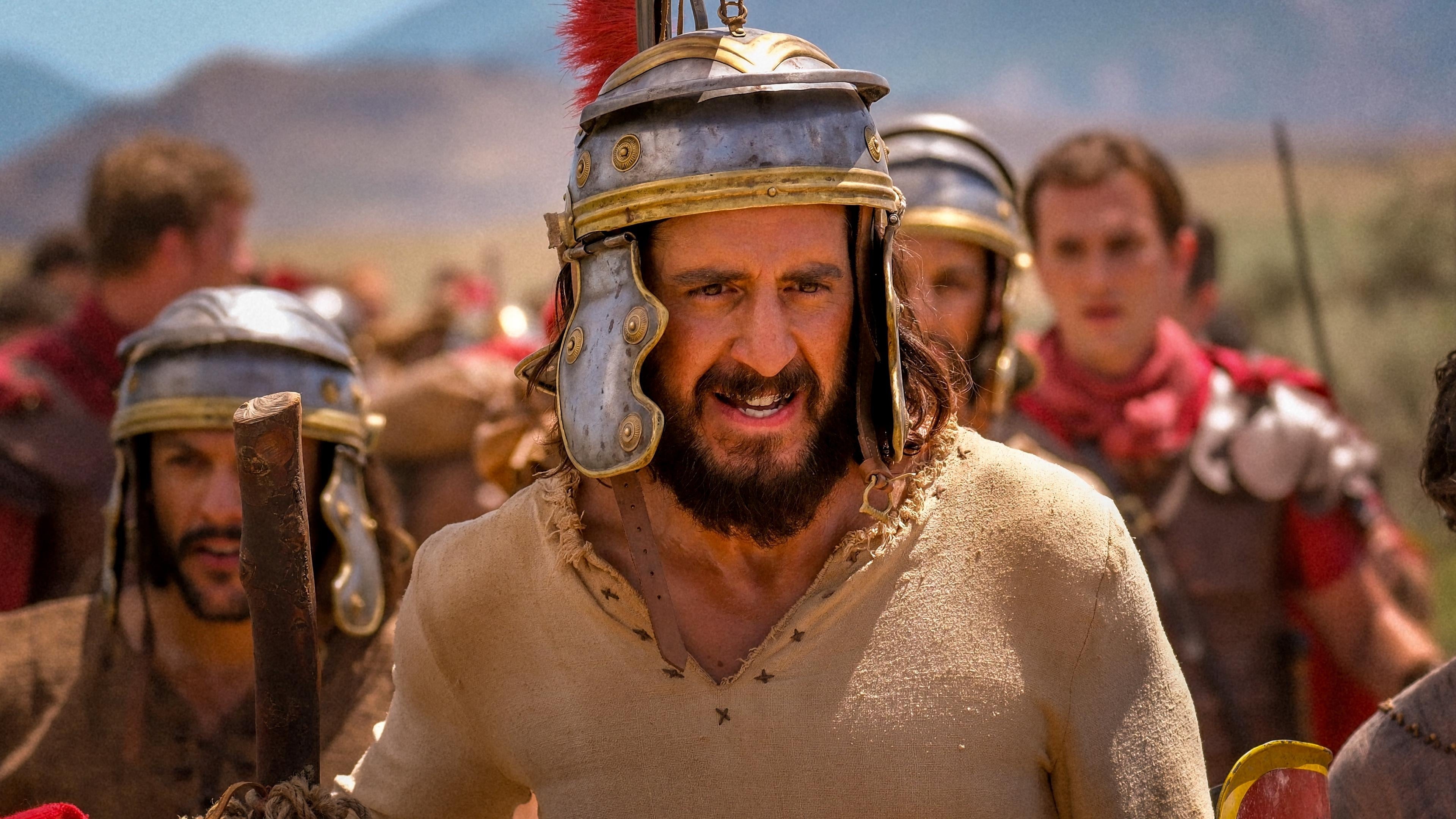

Summary of Episode 4
The episode unfolds in the shadow of Ramah’s death. Thomas, along with the rest of the disciples, wrestles with grief and unanswered questions about whether Jesus, or anyone else, could have acted differently. Words of comfort fall short. What Thomas longs for is not explanation, but presence, someone willing to sit with him in his pain.
That same need surfaces in Jesus. Worn down by the disciples’ ongoing arguments about greatness and authority, he seeks out Thaddeus and Little James, disciples who rarely push themselves forward and with whom he can simply be.
Humility and power run throughout the episode. Quintus, once confident and cruel with authority, is brought low, while Gaius, marked by restraint and integrity, is elevated. This reversal reflects a familiar biblical pattern: those who exalt themselves are humbled, and those who humble themselves are lifted up. When Gaius later approaches Jesus believing his own sin makes him unworthy, Jesus identifies this posture as genuine faith, declaring he has not found such faith even among Israel.
Meanwhile, Big James and John assume their loyalty earns them special status in Jesus’ kingdom. Jesus responds by speaking of a cup they do not yet understand—a cup of suffering and death. True authority, he teaches, is revealed not through position, but through giving one’s life for others.
The disciples struggle to grasp this, and their arguments deepen Jesus’ isolation. After sending them ahead, Jesus watches olives being crushed in the press and prays the psalmist’s words about friends and companions standing far off. Gaius then approaches and embraces him, offering, through his presence, the comfort Jesus’ own disciples failed to give.
Time for Personal Reflection and Summary
After the episode, invite participants to take a few moments of silence to reflect on what they’ve just experienced. Encourage them to think about what resonated with them, what caught them by surprise, or what was unclear. Next, invite them to think about the characters and consider whether they can identify with them or their situations. Encourage them to write down their thoughts or prepare them for a group discussion.
After a few moments of quiet reflection, invite the group to share the moments from the episode that stood out to them. You can use the “Episode Summary” to help you with this. Try to fill in the details you have noticed are missing from the summary. You can also use more creative methods to compose the summary.
Tip: For a more interactive way to summarize the episode, try using a mind map, The 5W1H Method, or other creative approaches. You can find these in the Leader Resources section online.
Some of the series’ concepts and themes may not be clear to all participants. A “Glossary of Terms” is provided to help with this.
Bible References
Primary Verses
Psalm 38:3–11
Isaiah 55:8-9
Matthew 8:5–13; 16:21; 20:17–28
Mark 8:31; 10:32–45
Luke 7:1–10; 9:22; 18:31–43
Supporting Verses
Matthew 9:27–33; 17:22–23
Mark 9:30–32; 10:46–52
Luke 9:43–45
John 4:46–54
Discussion
In the next section, you will facilitate the group discussion. You can use the questions in their entirety or select those relevant to your group.
What resonated most with you in this episode, and why?
The disciples face two painful losses close together. What are some healthy ways to cope when life feels overwhelming?
In his grief, Ramah’s father loses control and says painful things. How did that scene affect you? What does it reveal about how anger and sorrow are connected?
Many intense emotional moments in this episode end with silence, closeness, or an embrace, often with Jesus. What do you notice about how comfort is shown, and not just explained, in these scenes?
During the episode, we see people respond to pain and threats in very different ways. Which response felt most familiar to you, and why?
• Kafni responding with anger and blame
• Roman soldiers enforcing control
• Pharisees judging and accusing
• The disciples reacting with fear, confusion, or ambitionGaius falls to his knees and calls Jesus “Lord,” even though he had listed many reasons why he had felt unworthy just moments before. Read Matthew 8:5-13 together. What stands out to you about how Jesus responds to Gaius’ faith?
James and John ask for places of honor at Jesus’ right and left hand. When you hear their request, what do you think that reveals about their characters? What do you think they misunderstand about Jesus and his kingdom?
Jesus says he came to give his life as a ransom for many (Mark 10:45). As you hear that, what do you think Jesus is offering to people, and what do you think that he is offering you right now?
After professing faith in Jesus, Gaius returns home and removes the household shrines to other gods. What do you think that action represents? What, if anything, have you had to leave behind—in your heart or your habits—to follow Jesus more honestly?
Jesus responds to Big James and John by speaking about a “cup” and later says he came not to be served but to serve. Read Mark 10:35-45. How does Jesus redefine greatness and leadership here?
In the final scene, Jesus withdraws, alone and visibly burdened, while oil is poured out nearby. What do you think might be weighing on him in that moment, and what does this tell us about following him?
This question may open a natural Gospel-sharing conversation.
Basic Questions
This first set of questions is straightforward and open-ended—great for seekers or those new to faith.
Advanced Questions
These questions are more in-depth and best suited for Christians and more mature participants. Use your discretion to select the ones that best fit your group.
Conclusion
At the close of the discussion time, take a moment to highlight the main ideas that came up during your conversation. The questions in this club meeting touched on the theme of “greatness and power,” and whether we pursue status or trust Jesus’ way of humble, sacrificial leadership.
You can read the quote from the episode below as a final reflection and encouragement. Invite participants to reflect on the message of this episode and consider how it might speak into their own lives.
KEY TAKEAWAY
“I am not worthy to have you come into my home . . . but you only need to say the word and he will be healed.”
—Gaius to Jesus
Afterward, you may want to allow a short moment of silence, prayer, or a smooth transition into the next activity.
Gospel Sharing Moment
As you lead discussions during this episode, keep in mind that the gospel message can naturally flow from your conversations. If the moment feels right, take the opportunity to share the Good News and invite participants to respond.
In this episode, we see people approach Jesus from very different places, grief, fear, doubt, ambition, and deep humility. Gaius comes aware of his unworthiness, yet Jesus meets him with mercy and authority. That movement lies at the heart of the gospel: we do not come to Jesus because we are strong or deserving, but because we trust him.
If the moment feels right, you may briefly share how you first reached out to Jesus, whether in desperation, uncertainty, or quiet hope, and what you discovered about who he is. If participants want to explore that step further, invite them to the “Following Jesus: Your First Step” section of this website (linked below).
Following Jesus: Your First StepSuggested Accompanying Activities
This can be at the beginning or the end of the meeting.
Design the Next Chapter. Choose Gaius, Thomas, or Jesus to design and draw a cover image for the character’s next chapter. Use a title, colors, and symbols to show what they are carrying, what is changing, and the pressures ahead. If comfortable, add one symbol representing a change in their own lives. Invite participants to explain their choices.
The Unexpected Twist. In pairs, create a simple plan for a trip, meal, or celebration. After 30 seconds, each pair draws a surprise “twist” card—a canceled train, burst pipe, or missing ingredient—and has one minute to adapt (cards must be prepared in advance). Share creative solutions. Note that while the game is playful, the episode explores the deeper shock of suddenly losing control.
You can find suggestions for extra games and activities in the Group Activities Library on the Leader Resources page.
Glossary of Terms
Kislev
The third month of the Jewish civil year and the ninth month of the religious year, usually falling in November–December. It is associated with the darker days of the year and themes of endurance and trust.

Firstfruits / the First Press
In the Bible, God’s people were commanded to offer the first and best of their harvest to the Lord, known as firstfruits (Exod. 23:19; Deut. 18:4). Olive oil and wine were produced through pressing, a process that became a powerful biblical image. In the New Testament, this language is applied to Jesus, whose suffering and death are presented as the firstfruits of new creation (1 Cor. 15:20). In this sense, Jesus becomes the one who is “pressed” and offered to God, so that new life may follow.
Publican (Tax Collector)
A publican was a private contractor authorized by Rome to collect taxes, often abusing this power for personal profit, which made them socially despised but politically protected. (See also Season 1, Episode 1.)
Son of Man
The Son of Man was a title drawn from Daniel 7:13, where it describes a figure with authority, glory, and eternal dominion—widely understood as referring to the Messiah. When Jesus used this title for himself, it shocked the Pharisees. For them, it wasn’t just bold; it was a claim to divine authority, which they could not accept.
Cohortes Urbanae
These were Roman military units established by Emperor Augustus to provide additional protection for the emperor and the city of Rome. Over time, they expanded to help maintain public order in Rome and other cities where they were stationed. In The Chosen, Atticus is portrayed as a member of this elite unit.