
Summary of Episode 3
The episode begins with a glimpse of Jesus’ childhood, playing with a friend under the watchful care of Mary and Joseph. Years later, Jesus visits Mary in Nazareth. She welcomes him with joy, they share a meal, and talk honestly. Jesus asks about a small wooden chest from his past. Mary hesitates, then agrees. Inside, he finds a bridle with deep family significance.
The heart of the episode comes during the festival of Rosh Hashanah, a time of reflection and renewal. In the synagogue, Jesus reads from Isaiah 61, a passage about good news for the poor and freedom for the oppressed. Then he says, “Today, this scripture is fulfilled in your hearing.” The meaning is unmistakable. Jesus is claiming to be the one Isaiah described. Many are stunned. Rabbi Benjamin objects, insisting Israel has no spiritual debt, but Jesus challenges that idea. Heritage alone cannot bring salvation.
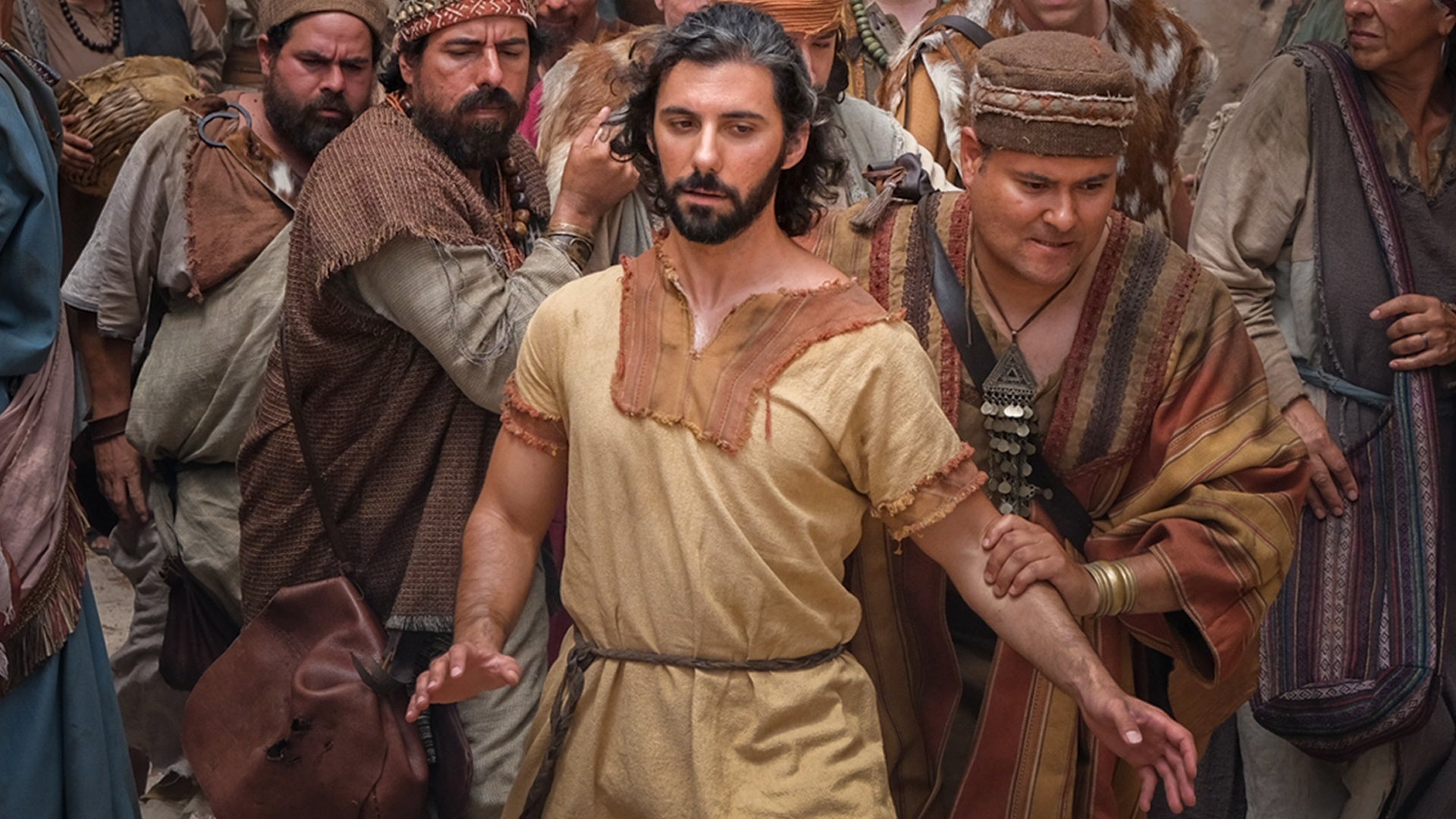
The response turns hostile. Jesus is accused of blasphemy. The crowd forces him out of Nazareth and attempts to kill him, but he tells them it is not yet his time. As he walks through the mob, they cannot stop him.
Later, Jesus visits Joseph’s grave, and a memory returns. In a flashback, Joseph teaches him to read using Isaiah 61 and explains what it means to have a broken heart. He shows Jesus the bridle, passed down since the Exodus, a reminder of God’s rescue. He tells Jesus that raising him has been the greatest honor of his life.
In the final scene, Jesus tells Mary he had to speak the truth he did and that there is no turning back. It will be his last visit to Nazareth.
Time for Personal Reflection and Summary
After the episode, invite participants to take a few moments of silence to reflect on what they’ve just experienced. Encourage them to think about what resonated with them, what caught them by surprise, or what was unclear. Next, invite them to think about the characters and consider whether they can identify with them or their situations. Encourage them to write down their thoughts or prepare them for a group discussion.
After a few moments of quiet reflection, invite the group to share the moments from the episode that stood out to them. You can use the “Episode Summary” to help you with this. Try to fill in the details you have noticed are missing from the summary. You can also use more creative methods to compose the summary.
Tip: For a more interactive way to summarize the episode, try using a mind map, The 5W1H Method, or other creative approaches. You can find these in the Leader Resources section online.
Some of the series’ concepts and themes may not be clear to all participants. A “Glossary of Terms” is provided to help with this.
Bible References
Isaiah 61:1-2
Luke 4:16-30
Matthew 13:53-58
1 Kings 17:8-24
2 Kings 5:1-14
Deuteronomy 18:20
Discussion
In the next section, you will facilitate the group discussion. You can use the questions in their entirety or select those relevant to your group.
What resonated most with you in this episode, and why?
We all act a little differently depending on our surroundings. What’s something that feels natural for you at home but might surprise people who only know you in public?
In this episode, Jesus reconnects with a former teacher. Who has shaped the way you think or live in a lasting way? Can you share an example? For example, a teacher, mentor, or even someone you just learned from.
The people of Nazareth struggle to see Jesus as more than Joseph’s son. How can familiarity make it harder to take someone seriously?
In the synagogue, Jesus challenges a very religious crowd by saying they are missing what God is really doing. What does it look like when someone is very religious but still disconnected from God?
Jesus reads from Isaiah 61 in the synagogue and then says, “Today this Scripture is fulfilled in your hearing.” Read Isaiah 61:1–2 together. What do you think would have made that moment so unsettling for the people listening?
Jesus stops before “the day of vengeance,” challenging expectations and stirring anger.
The people of Nazareth are excited about Jesus at first, but quickly turn against him. Why do you think hope can turn into anger when expectations are challenged?
Jesus doesn’t change his message, even when it costs him acceptance. What does that show you about his character?
Why is it so easy to soften or avoid the truth to fit in?
Jesus retrieves a family heirloom, a bridle passed down through generations. What do you think the bridle represents for Jesus?
When Jesus says, ’a prophet is not welcomed in his own hometown,’ he echoes a common theme in Scripture, that God’s prophets were often rejected by the very people they were sent to. What role did prophets actually have? And can you think of another prophet in the Bible who was rejected or not listened to by his own people?
Isaiah 61 describes God’s healing and freedom, not the political or personal gain many expected.
Jesus reads Isaiah 61:1-2 in the synagogue and claims it is fulfilled in himself. How does this passage describe what Jesus says he has come to do, and why might that be misunderstood?
Jesus is misunderstood in his own hometown, but he doesn’t change his message to fit in. Where or when do you find it hardest to speak honestly about your faith with people who already know you well?
Basic Questions
This first set of questions is straightforward and open-ended—great for seekers or those new to faith.
Advanced Questions
These questions are more in-depth and best suited for Christians and more mature participants. Use your discretion to select the ones that best fit your group.
Conclusion
At the close of the discussion time, take a moment to highlight the main ideas that came up during your conversation. The questions in this club meeting touched on the themes of “familiarity and authority,” and how genuine faith is revealed when Jesus speaks in ways that challenge what we assume, expect, or feel comfortable with.
You can read the quote from the episode below as a final reflection and encouragement. Invite participants to reflect on the message of this episode and consider how it might speak into their own lives.
KEY TAKEAWAY
“Are you claiming to be more than a rabbi?”
—Aaron
Afterward, you may want to allow a short moment of silence, prayer, or a smooth transition into the next activity.
Suggested Accompanying Activities
This can be at the beginning or the end of the meeting.
Provide a special snack at your meeting. Prepare a traditional Jewish dish to celebrate Rosh Hashanah (the Jewish New Year). For example, you could bake challah together.
Try the activity “Two Faces.” Ask each person to draw a mask with two sides—one showing how they present themselves “to others,” and the other showing how they are “at home.” Invite them to share what each side represents. This simple activity encourages reflection on how our behavior can change depending on our surroundings, and what it means to live as our true selves.
Play “Trigon,” the game Jesus played with his childhood friends. This fast-paced, three-player ball game is best played outdoors, but it can also be enjoyed indoors. Players toss a small ball quickly between each other, always catching it with their left hand and throwing it with their right, trying not to drop it. If someone misses, they lose a “life” or complete a fun penalty. The pace can increase as the game progresses, making it a lively challenge that requires focus and coordination.
You can find suggestions for extra games and activities in the Group Activities Library on the Leader Resources page.
Glossary of Terms
Rosh Hashanah
Literally “head of the year,” Rosh Hashanah is the Jewish New Year that frames this episode. Celebrated on the first two days of the Jewish month Tishrei (usually in September), it begins a ten-day period of reflection leading up to Yom Kippur. Traditions include blowing the shofar as a spiritual wake-up call, greeting “L'shana tovah” (a good year), and eating apples with honey.

L’shana Tovah
A Hebrew greeting used during Rosh Hashanah, meaning “for a good year.” It's a way of wishing someone blessings and goodness in the year ahead.
Challah
A braided white bread typically served during Shabbat dinner and holidays. It's soft, slightly sweet, and often topped with sesame or poppy seeds.
Beit Midrash
Translates as a “house of study.” It's a place where Jewish people gather to study the Torah and other sacred texts. It's often connected to a synagogue, but may also be a separate space for group or individual learning.
The Widow of Zarephath
A story in 1 Kings 17:8-24. During a drought, God sends the prophet Elijah to a widow in Zarephath. She has only enough flour and oil for one last meal with her son, yet Elijah asks her to feed him first. Trusting God’s promise, she obeys, and her flour and oil never run out, providing for them all through the famine.
Naaman the Syrian
A Syrian army commander with leprosy (2 Kings 5:1–14). Encouraged by a servant girl, he sought healing from Elisha. After hesitating to follow the prophet’s simple command to wash in the Jordan, he obeyed, was healed, and came to believe in Israel’s God.
Bridle
Drawn from James 3, which discusses a horse’s bridle, the image portrays discipleship as submission: allowing Christ to direct our passions, impulses, and even our words, rather than living unrestrained or independently.