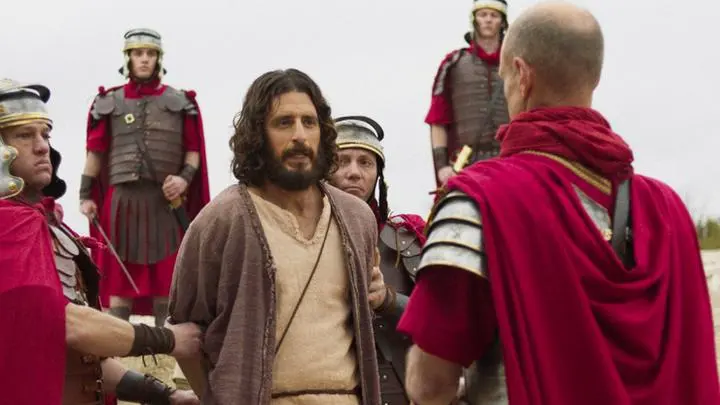

Summary of Episode 6
The episode opens with a scene from the Old Testament, where the priest Ahimelech explains to his son the meaning of the sacred bread kept in the sanctuary. Soon after, David arrives, fleeing from King Saul, and asks for food for himself and his men. Though it breaks ritual law, Ahimelech gives him the bread. David insists that life matters more than ritual. At the end of the episode, Jesus refers to this story when the Pharisees criticize his disciples for picking grain on the Sabbath. Jesus responds that they don’t understand what it means: “I desire mercy, not sacrifice.”
At Jesus’ request, Matthew and Simon go looking for Mary Magdalene, who had left the group but is now overwhelmed by guilt and doubt. She hides in an inn, trying to numb her pain with wine and gambling. When tensions rise at the table, fear overtakes her, triggering painful memories from childhood and the words of her father.
She recalls the verse she repeated with her father: “Do not be afraid, for I have redeemed you; I have called you by name; you are mine” (Isaiah 43:1). She runs from the inn, leaving her winnings behind. When Matthew and Simon find her, she says she no longer deserves to return. They remind her how much she has meant to the others. Encouraged, she returns. Jesus welcomes her and says that it wouldn’t be “much of a redemption if it could be lost in a day.”
Meanwhile, the disciples receive troubling news—John the Baptizer has been arrested. Andrew and Philip are especially shaken. Simon the Zealot proposes a rescue, but others insist that is not the way.
The episode also shows the Pharisees’ growing hostility toward Jesus. Shmuel asks his superiors for permission to accuse Jesus, but they deny him, citing a lack of evidence. Tension rises when Jesus heals a man’s paralyzed hand in the synagogue on the Sabbath, further provoking the religious leaders, who begin planning how to stop him.
Time for Personal Reflection and Summary
After the episode, invite participants to take a few moments of silence to reflect on what they’ve just experienced. Encourage them to think about what resonated with them, what caught them by surprise, or what was unclear. Next, invite them to think about the characters and consider whether they can identify with them or their situations. Encourage them to write down their thoughts or prepare them for a group discussion.
After a few moments of quiet reflection, invite the group to share the moments from the episode that stood out to them. You can use the “Episode Summary” to help you with this. Try to fill in the details you have noticed are missing from the summary. You can also use more creative methods to compose the summary.
Tip: For a more interactive way to summarize the episode, try using a mind map, The 5W1H Method, or other creative approaches. You can find these in the Leader Resources section.
Some of the series’ concepts and themes may not be clear to all participants. A “Glossary of Terms” is provided to help with this.
Bible References
- Luke 6:6-11
- Matthew 12:1-14
- Psalm 19:7
- Psalm 20:7
- Luke 8:1-3
- 1 Samuel 21:1-6
Discussion
In the next section, you will facilitate the group discussion. You can use the questions in their entirety or select those relevant to your group.
What resonated most with you in this episode, and why?
Have you ever broken a rule because you believed what you were doing was more important? What happened as a result?
The disciples faced growing challenges in this episode: Mary’s disappearance, John the Baptizer’s arrest, and religious opposition. How do you think they handled these pressures? How does their reaction compare to how Jesus responded?
When the disciples asked what they should do, prayer was Jesus’ first response. In your own life, is prayer usually your first or last response? Why do you think it can be hard to turn to prayer first when dealing with problems?
Why do you think Mary decided to leave the disciples and Jesus? What emotions or struggles might have led to her decision?
Mary, in a moment of weakness, returns to an old way of life. Have you ever made a change or commitment, only to find yourself struggling with the same challenge again? What was that experience like for you?
In this episode, we see repeated clashes between Jesus and the Pharisees. What exactly bothered the Pharisees about Jesus, and what bothered Jesus about the Pharisees? Why do you think their approach to God’s law was so different from his?
Do you see signs of “Pharisee-like” behavior today—whether at school, at work, or even in church? How can we stay focused on what truly matters, rather than getting caught up in rules or traditions? How does Jesus’ example help us keep the proper perspective?
Read Psalm 19:7. Reflecting on Jesus’ compassion in this episode, how can this verse help us see God’s commands as something good, not a burden? What’s one way you could show more understanding and compassion to someone this week?
After healing a man in the synagogue, Jesus tells the Pharisees, “If you had known what this means, ‘I desire mercy, not sacrifice,’ you would not have condemned the guiltless.” He then adds, “the Son of Man is Lord even of the Sabbath.” Read the account in Matthew 12:1–8. What do you think Jesus meant by these words? How could they shape the way you live out your faith today?
Although Mary Magdalene’s return to her old life is not recorded in Scripture, the theme of grace and forgiveness is prevalent throughout the Bible. Can you think of a story in the Bible that shows this same principle? How do these stories reflect God’s heart for grace and forgiveness when people fail?
Consider stories like the prodigal son (Luke 15:11-32), The Parable of the Unmerciful Servant (Matthew 18:21-22), or Peter’s denial and restoration (John 21:15-19; Matthew 26:33–35 and 26:69–75).
In this episode, Rama says that nothing good can come from Mary’s disappearance. But Mary, the mother of Jesus, reminds her with the words of Psalm 20:7—that we must trust God even when we don’t understand. Have you ever had a moment when you had to trust God despite difficult circumstances? How did God use that moment in your life?
Other encouraging Bible verses about not worrying and trusting God include Matthew 6:25–27, 33–34; Philippians 4:6–7; and 1 Peter 5:7.
Basic Questions
This first set of questions is straightforward and open-ended—great for seekers or those new to faith.
Advanced Questions
These questions are more in-depth and best suited for Christians and more mature participants. Use your discretion to select the ones that best fit your group.
Conclusion
At the close of the discussion time, take a moment to highlight the main ideas that came up during your conversation. The questions in this club meeting touched on the themes of "rules and legalism" and "a new understanding of the law."
You can read the quote from the episode below as a final reflection and encouragement. Invite participants to reflect on the message of this episode and consider how it might speak into their own lives.
KEY TAKEAWAY
“If you had known what this means, ‘I desire mercy, not sacrifice,’ you would not have condemned the guiltless.”
–Jesus
Afterward, you may want to allow a short moment of silence, prayer, or a smooth transition into the next activity.
Gospel Sharing Moment
As you lead discussions during this episode, keep in mind that the gospel message can naturally flow from your conversations. If the moment feels right, take the opportunity to share the Good News and invite participants to respond.
In Episode 6, Mary returns after walking away, burdened by shame and failure. Instead of rejecting her, Jesus receives her back with gentleness and love. Her story powerfully echoes the Gospel’s message: God doesn’t give up on us—even when we give up on ourselves.
You might consider sharing a personal story about a time when you realized your own priorities were out of line with Jesus’ example. His invitation isn’t just to observe him—it’s to follow him. Moments like this can help others relate and see their own need for the Gospel.
If someone wants to know more about what that means, you can turn to the section "Following Jesus: Your First Step" at the end of this guide. It explains how to begin a relationship with Christ—and how to respond to his call.
Suggested Accompanying Activities
This can be at the beginning or the end of the meeting.
- Invite participants to reflect individually on situations where they could show more understanding and compassion in the coming week. Encourage them to think practically about how to live this out in their daily routines.
- Take a moment to write down how it feels when someone forgives you. Then, think of someone who may be waiting for your forgiveness. Imagine offering them the same gift that was once given to you. What emotions does that stir up in you?
- You can find suggestions for extra games and activities looking at the Group Activities Library on the Leader Resources page.
Glossary of Terms
Ahimelech
Ahimelech was the priest mentioned in 1 Samuel 21–22. When David fled from King Saul, he visited Ahimelech at the sanctuary with his men. Although only priests were permitted to eat the sacred showbread that had just been replaced, Ahimelech gave it to David. Although this technically violated ritual law, God did not punish David, showing that mercy and human need took precedence over ritual rules. Jesus later refers to this story when defending his disciples from criticism, pointing out that if the Pharisees condemned him, they would also have to condemn David—something they were unwilling to do, fearing public backlash.

Eating grain on the Sabbath
According to their interpretation of the Law and Jewish tradition, the Pharisees had identified 39 categories of actions forbidden on the Sabbath, including harvesting. When Jesus’ disciples picked grain and rubbed it in their hands to eat, the Pharisees accused them of breaking the Sabbath law. But the disciples weren’t harvesting for profit—they were simply hungry. The Pharisees fixated on the external rule, missing the heart behind the law. Their goal was not true justice or compassion, but to trap Jesus and protect their own authority.
Son of Man
The Son of Man was a title drawn from Daniel 7:13, where it describes a figure with authority, glory, and eternal dominion—widely understood as referring to the Messiah. When Jesus used this title for himself, it shocked the Pharisees. For them, it wasn’t just bold; it was a claim to divine authority, which they could not accept.