Summary of Episode 4
This episode weaves together three storylines. The first begins with a young boy named Yeshua (also called Jesse), who becomes paralyzed after falling from a tree. His brother Simon becomes his caretaker, but their paths diverge when Simon joins the radical Zealot movement. Left behind, Jesse settles near the Pool of Bethesda, where he waits for years, hoping to be the first to enter the water when it stirs and be healed. That moment never comes. Meanwhile, Simon is sent on a mission to assassinate a Roman official in Jerusalem, unaware he’s being followed by a Roman named Atticus, who plans to kill him during the attack.
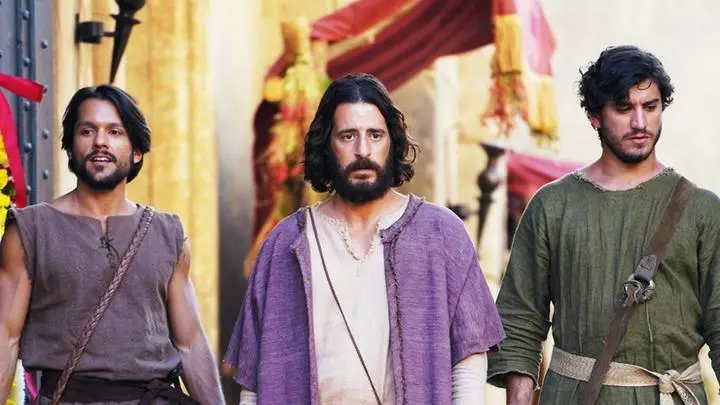
The second storyline follows Jesus and the disciples as they travel to Jerusalem for the Feast of Tabernacles. Like other pilgrims, they build temporary shelters to remember Israel’s time in the wilderness. During a meal, Jesus teaches about the meaning of the feast and shares messianic prophecies.
In the third storyline, the disciples overhear Rabbi Shmuel preaching in Jerusalem. Once a student of Nicodemus, Shmuel has gained a following by warning against heresy, clearly referring to Jesus. The disciples report this back to him.
All three stories converge at the Pool of Bethesda. Jesus brings John, Simon, and Matthew to the site and heals Jesse. The Pharisees are outraged—not only that Jesus healed on the Sabbath, but that he told Jesse to pick up his mat and walk, an act they considered unlawful “work.” To them, Jesus had not only broken Sabbath tradition, but encouraged others to do the same. They try to question the man, but he runs to find his brother.
Just as Simon the Zealot prepares to strike the Roman official, he sees his brother standing. The moment fulfills the words from a letter he once wrote: “Jesse, when you stand on two feet, I will know the Messiah has come.” As they leave the city, Matthew asks, “Why did you do this on Shabbat?” Jesus smiles and replies, “Sometimes you gotta stir up the water.”
Time for Personal Reflection and Summary
After the episode, invite participants to take a few moments of silence to reflect on what they’ve just experienced. Encourage them to think about what resonated with them, what caught them by surprise, or what was unclear. Next, invite them to think about the characters and consider whether they can identify with them or their situations. Encourage them to write down their thoughts or prepare them for a group discussion.
After a few moments of quiet reflection, invite the group to share the moments from the episode that stood out to them. You can use the “Episode Summary” to help you with this. Try to fill in the details you have noticed are missing from the summary. You can also use more creative methods to compose the summary.
Tip: For a more interactive way to summarize the episode, try using a mind map, The 5W1H Method, or other creative approaches. You can find these in the Leader Resources section.
Some of the series’ concepts and themes may not be clear to all participants. A “Glossary of Terms” is provided to help with this.
Bible References
- John 5:1-16
- Psalm 69:9
- Zechariah 8:20-23
- Isaiah 35:3–6
- Exodus 20:8-11
- Leviticus 23:33–43
Discussion
In the next section, you will facilitate the group discussion. You can use the questions in their entirety or select those relevant to your group.
What resonated most with you in this episode, and why?
Simon was trained as a Zealot—part of a group willing to kill in the name of God. Today, they would likely be considered part of an extremist group. What are some common traits of extremist groups?
Some possible traits:
- They promote radical or extreme views that differ sharply from the majority
- They have a one-sided, uncompromising worldview
- They justify the use of violence or threats to achieve their goals
- They often isolate themselves and feel morally superior
- They reject diversity
- They use misinformation
- They follow strong, charismatic leaders who demand loyalty and discipline
How do you usually respond when someone expresses a viewpoint different from or opposite to your own? Where do you think the boundary lies between respecting someone’s opinion and standing firm in your own convictions?
What helps you set healthy boundaries in your life—at school, at work, in friendships, dating relationships, or family? How do you define personal boundaries, and what role does your faith or personal conviction play in that?
How do you tend to respond when someone crosses a boundary in your life? Can you think of a specific situation and how you handled it?
In this episode, the disciples join Jesus to celebrate the Feast of Tabernacles—a reminder of how the Israelites wandered through the wilderness for 40 years. During the meal, Jesus says, “Everyone has wandered through the wilderness at some point.” What do you think he meant by that? Have you ever experienced a “wilderness” season in your own life? What did you learn from it?
Read John 5:1–16 and compare it with how the episode portrays the healing of the paralyzed man at the Pool of Bethesda. What similarities or differences stood out to you? Did seeing it on screen change or deepen your understanding of the story?
The episode shows two kinds of suffering—Yishai’s physical pain and Simon’s emotional wounds from the past. Each copes with pain in very different ways. What helps you when you go through painful or difficult seasons?
Note: This question invites honest reflection. Be sensitive to your group’s comfort level when discussing personal pain or trauma.
Was there a quote or a specific moment in this episode that really spoke to you or stayed with you? What do you think made it so meaningful?
The Pharisees and the Zealots both read the same Scriptures—yet they responded in very different ways. How do you think it’s possible for people to read the same Bible and reach such opposing conclusions? What do you do to make sure you’re understanding something in the Bible—or about God—correctly?
During the building of the tent, Jesus and his disciples pause to remember the Feast of Tabernacles. Read Leviticus 23:33–43, where God outlines the purpose and practices of this festival. What deeper meaning did this feast hold for the people of Israel? How might those same themes apply to your life today?
Read Matthew 7:21-23, where Jesus warns that not everyone who claims to know him truly does. What do you think are the marks of a genuine follower of Jesus?
Basic Questions
This first set of questions is straightforward and open-ended—great for seekers or those new to faith.
Advanced Questions
These questions are more in-depth and best suited for Christians and more mature participants. Use your discretion to select the ones that best fit your group.
Conclusion
At the close of the discussion time, take a moment to highlight the main ideas that came up during your conversation. The questions in this club meeting touched on the themes of "extremism" and "boundaries."
You can read the quote from the episode below as a final reflection and encouragement. Invite participants to reflect on the message of this episode and consider how it might speak into their own lives.
KEY TAKEAWAY
“Everyone has wandered through the wilderness at some point.”
—Jesus
Afterward, you may want to allow a short moment of silence, prayer, or a smooth transition into the next activity.
Suggested Accompanying Activities
This can be at the beginning or the end of the meeting.
- Plan a group or individual activity that gently pushes participants out of their comfort zone and into something a bit unfamiliar or challenging. Ideas might include: paintball, a winter hike, cold water immersion, or even something fun like karaoke.
- You can find suggestions for extra games and activities looking at the Group Activities Library on the Leader Resources page.
Glossary of Terms
Feast of Tabernacles (Sukkot)
This Jewish festival, called Sukkot in Hebrew (meaning “booths” or “tents”), is one of the three pilgrimage festivals, along with Passover and Pentecost. Every Jewish man was expected to travel to Jerusalem to celebrate it. The seven-day feast commemorates Israel’s time in the wilderness after the exodus from Egypt, when they lived in temporary shelters. During the celebration, participants build and dwell in sukkahs (tents or booths), symbolizing Israel’s dependence on God and the temporary nature of earthly life. It’s also a time of gratitude for God’s provision and blessing.

Zealots
The term “zealot” (from the Greek zélótés – “one who is zealous”) refers to various Jewish resistance groups that opposed Roman rule and the reign of Herod the Great. Under the leadership of Judas the Galilean, the Zealots advocated for active, even violent, rebellion against Rome. Their radical movement eventually contributed to the outbreak of the Jewish War (66–70 AD). In the series, Simon (the Zealot) quotes Psalm 69:10 in his farewell letter to his brother: “Zeal for your house has consumed me; the insults of those who insult you fall on me.” This verse captures both Simon’s passionate devotion and his inner conflict about violence and faith.
Cohortes Urbanae
These were Roman military units established by Emperor Augustus to provide additional protection for the emperor and the city of Rome. Over time, they expanded to help maintain public order in Rome and other cities where they were stationed. In The Chosen, Atticus is portrayed as a member of this elite unit.
Shabbat (Sabbath)
Shabbat is the Jewish day of rest, observed from Friday evening to Saturday evening. It is the most sacred day in Judaism, marked by the command: “Remember the Sabbath day, to keep it holy” (Exodus 20:8). By Jesus’ time, many religious leaders—including the Pharisees—had added numerous detailed rules about what could and couldn’t be done. In this episode, the Pharisees are outraged that Jesus healed on the Sabbath and that the man carried his mat afterward. Jesus challenges their rigid interpretation, emphasizing that mercy and compassion are greater than rule-keeping.
Pool of Bethesda
Mentioned in John 5, the Pool of Bethesda was a place in Jerusalem where many sick or disabled people gathered, hoping to be healed when the waters were stirred. In the series, Yeshua (Jesse) spends years waiting by the pool, desperate for a miracle. The pool is surrounded by five colonnades and portrayed as a place of deep human suffering and faint hope. While some, like Simon the Zealot, doubted its power, Jesse longed for healing in whatever form it might come.