
Summary of Episode 1
The episode opens with a flashback to the beginning of John the Baptizer’s life. Early in her pregnancy, Mother Mary travels to visit her older relative Elizabeth. When Elizabeth hears Mary’s voice, the child in her womb leaps with joy. Elizabeth then recalls Zechariah’s encounter with the messenger and the special calling her son will one day have. This memory returns at the end of the episode, framing John’s story from beginning to end.
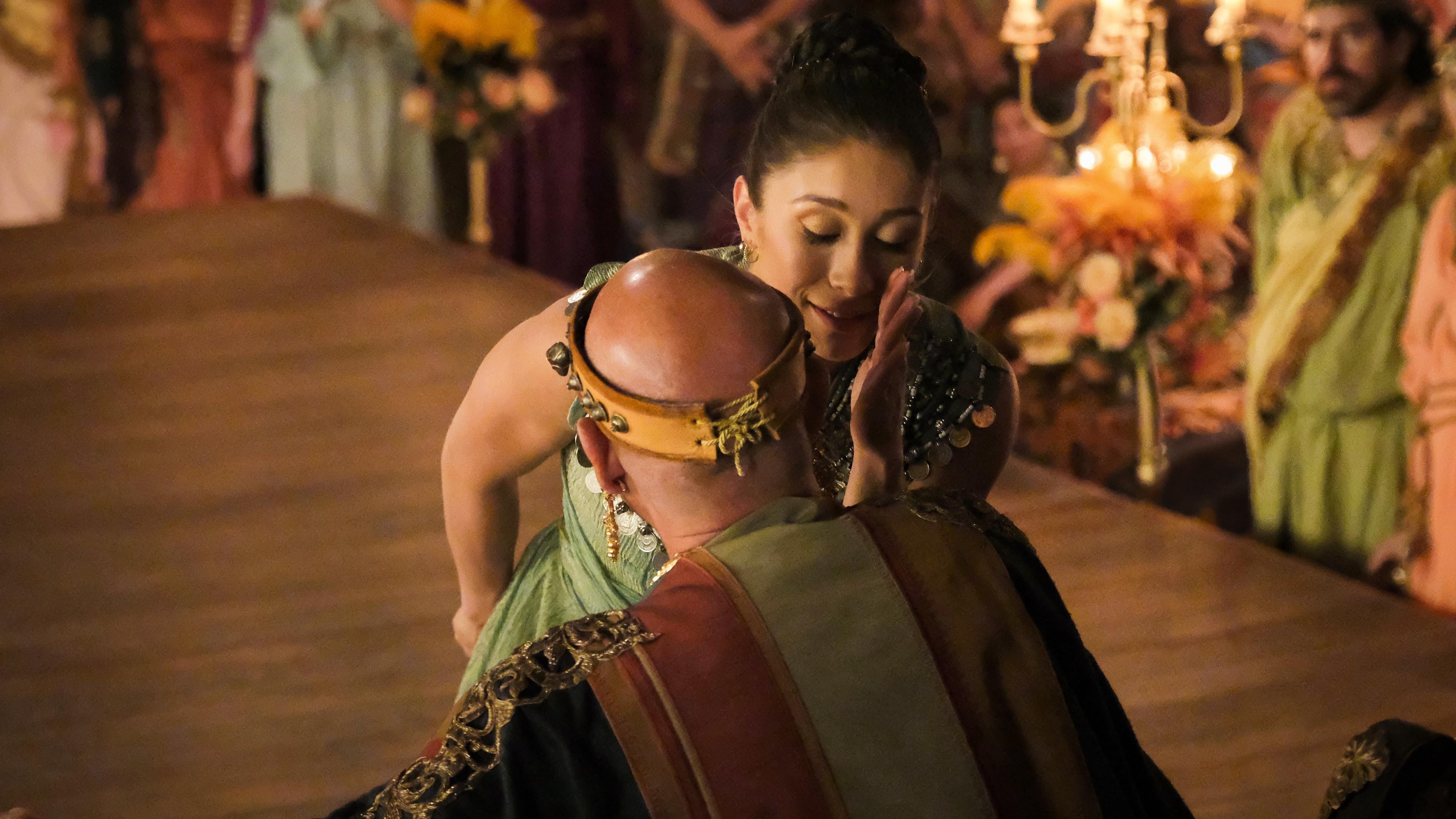
In the present day, a young Salome is being trained by her mother, Herodias, to perform a dance for Herod Antipas. Herodias is angry with John the Baptizer because he publicly spoke against her marriage, and she sees the king’s birthday celebration as her opportunity to silence him. At the lavish feast, Salome dances, Herod is pleased, and he promises to grant her any request. Guided by her mother, she asks for John’s head.
Before his execution, John speaks with quiet confidence about the coming “wedding feast of the Lamb.” His hope deepens when he sees a lamb, echoing the message he has proclaimed throughout his life. John is then put to death.
Alongside these events, several other stories unfold. In Capernaum, Zebedee and his sons secure their first major contract supplying oil to the synagogue, only to have their celebration cut short by news of John’s death. Ramah reunites with Thomas and explores a lawful path toward marriage, despite her father’s refusal to bless the union. Judas and Simon Z wrestle with differing views on money, responsibility, and trust in Jesus’ way of leading.
The episode closes as word of John’s death reaches Jesus and the disciples, leaving behind a deep sense of loss and reflection.
Time for Personal Reflection and Summary
After the episode, invite participants to take a few moments of silence to reflect on what they’ve just experienced. Encourage them to think about what resonated with them, what caught them by surprise, or what was unclear. Next, invite them to think about the characters and consider whether they can identify with them or their situations. Encourage them to write down their thoughts or prepare them for a group discussion.
After a few moments of quiet reflection, invite the group to share the moments from the episode that stood out to them. You can use the “Episode Summary” to help you with this. Try to fill in the details you have noticed are missing from the summary. You can also use more creative methods to compose the summary.
Tip: For a more interactive way to summarize the episode, try using a mind map, The 5W1H Method, or other creative approaches. You can find these in the Leader Resources section online.
Some of the series’ concepts and themes may not be clear to all participants. A “Glossary of Terms” is provided to help with this.
Bible References
Matthew 14:3-12
Mark 6:17-29
Luke 1:5-25; 1:39-45; 1:56-80
John 1:6-8; 1:15; 3:29
Discussion
In the next section, you will facilitate the group discussion. You can use the questions in their entirety or select those relevant to your group.
What resonated most with you in this episode, and why?
Promises play a role in several parts of this episode. When you hear the word “promise,” what comes to mind?
Early on, Judas and Simon Z are doing laundry together, a very ordinary and practical task. What did you notice about how each of them responded to this responsibility?
While doing the laundry, Simon tells Judas that he is “learned” but not wise. In your own words, what do you think wisdom is, and why isn’t it always the same as being educated?
Herod realizes he has promised far too much to Salome and instead of taking it back, he gives in to public pressure. In what kinds of situations do you notice pressure from others influencing your decisions?
Read Luke 1:16–17, which describes John’s role. What do you notice about what he is called to do? When you think about your future, what do you hope your life will be about?
In this episode, we see the deep grief of John’s friends after his death. When you think about loss in general, what do you notice helps people process their grief?
Optional follow-up: If you’re comfortable sharing, consider sharing about a personal experience you have had with grief or loss.
As the episode moves toward John’s death, it also flashes back to his father praising God at John’s birth. What do you think the episode is trying to show by placing promise, praise, and loss side by side?
Before his death, John speaks about going to a different kind of wedding or feast. Read Revelation 19:6–8 together. What connections do you notice between John’s words and this picture of the wedding feast?
In the final scenes, John faces death with gratitude and hope. How does his response compare with:
• how people generally think about death?
• how people talk about death today?
• how you personally think about death?While talking with Judas, Simon Z says they shouldn’t act like they’re above ordinary work or other people. As Christians, what could help us stay grounded and close to everyday people? What helps you?
Basic Questions
This first set of questions is straightforward and open-ended—great for seekers or those new to faith.
Advanced Questions
These questions are more in-depth and best suited for Christians and more mature participants. Use your discretion to select the ones that best fit your group.
Conclusion
At the close of the discussion time, take a moment to highlight the main ideas that came up during your conversation. The questions in this club meeting touched on the theme of “promises” and what we hold onto when hope feels threatened.
You can read the quote from the episode below as a final reflection and encouragement. Invite participants to reflect on the message of this episode and consider how it might speak into their own lives.
KEY TAKEAWAY
“We knew this day would come. We should have been prepared.”
—Andrew to Simon
Afterward, you may want to allow a short moment of silence, prayer, or a smooth transition into the next activity.
Suggested Accompanying Activities
This can be at the beginning or the end of the meeting.
Before you start the episode, briefly recap the main events of Season 3 to help everyone remember the story and understand the context.
Read Mark 6:17–29 aloud together. Then, invite participants to choose a character from the story (excluding John) and write a short journal entry on a piece of paper or on their phone from that character’s perspective, imagining it was written shortly after John’s death. After a few minutes, form small groups of 3–4 and invite participants to share what they wrote.
You can find suggestions for extra games and activities in the Group Activities Library on the Leader Resources page.
Glossary of Terms
Herod’s marriage
Herod Antipas married Herodias, who had previously been married to his half-brother Herod Philip (also known as Herod II). Under Jewish law, this union was considered unlawful. John the Baptizer publicly criticized the marriage, which led to his imprisonment and set the stage for his execution (Mark 6:17–29).

Kiddushin
Refers to the first stage of Jewish marriage and is often translated as “betrothal” or “sanctification.” It takes place in front of witnesses and includes a promise and a valuable gift from the groom to the bride. Through this act, a man and woman become legally bound to one another, even though they do not yet live together.
Oil in Jewish tradition
Oil holds rich symbolic meaning in Judaism, especially in religious rituals and ceremonies. Holy anointing oil, described in the Torah, was made from high-quality olive oil mixed with aromatic spices (Exodus 30:23–25). Holy oil was set apart for sacred use and could not be used for ordinary purposes.
Lamb of God
A biblical title for Jesus Christ that connects the Jewish tradition of sacrificial lambs with the Christian understanding of redemption. John the Baptizer uses this title when speaking about Jesus (John 1:29; John 1:36).
Tearing of garments
Tearing one’s clothing was a traditional Jewish expression of deep grief, mourning, or distress. It appears throughout the Old Testament as a physical sign of sorrow, shock, or lament in response to loss or tragedy (for example, Genesis 37:34; 2 Samuel 1:11; Job 1:20).