
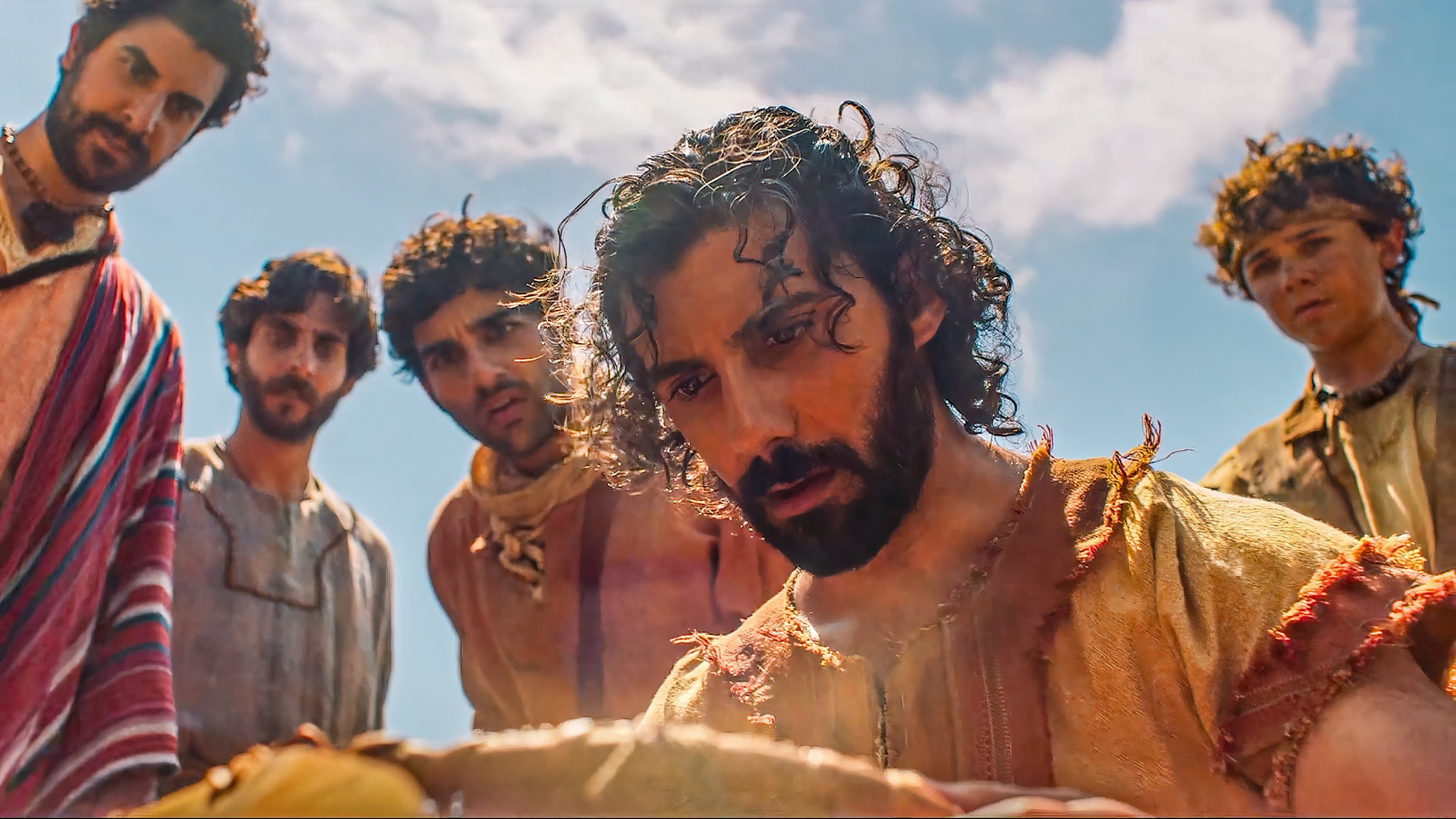
Summary of Episode 8
At the beginning of the episode, we see King David and his pregnant wife listening to Psalm 77. This psalm becomes a symbolic bridge to the story of Simon and Eden, who are grieving the loss of their child. Although the opening scene isn’t directly taken from Scripture, it beautifully captures the same depth of sorrow and hope found in the psalm. Eden finally speaks openly to her friends about her pain, expressing frustration that Jesus heals others while seeming absent from her own story. Her friends listen with compassion and encourage her to visit the synagogue and find comfort in God’s Word.
Meanwhile, in the Decapolis, tensions continue to rise. Jesus and his disciples face mockery from both Jews and Gentiles, but when he heals a man who cannot walk, the crowds fall silent and listen in awe. More and more people gather, and Jesus teaches late into the night and through the next day. Pharisees Shmuel and Yanni arrive, hoping to gather witnesses to accuse him before the council.
Jesus teaches about the Kingdom of God—how it welcomes the overlooked, values the humble, and often works in ways no one expects. When the disciples worry about feeding the massive crowd, Jesus invites them to offer what they have. With hesitation, Andrew and Telemachus bring five loaves and two fish. Jesus takes this small offering in his hands and says it is enough; and from that little, he provides for thousands.
Amid the celebration, Simon still carries his grief. Eden visits the synagogue, where Rabbi Yussif listens and reads Psalm 77 to comfort her. Later, she goes to the mikveh that Simon and Gaius had recently restored. The episode ends on the stormy sea, where the disciples are terrified until they see Jesus walking toward them. Simon steps out of the boat to meet him, but as doubt takes over, he begins to sink. Jesus catches him as Simon cries, “Don’t let go.”
Special Note
Because this episode is longer than usual, you might want to consider splitting it across two meetings. You could pause the episode at 47:12 (just after the disciples see their baskets full of fish and bread) and continue with the first set of questions. The following week, briefly review what you watched, finish the episode, and continue the discussion.
This gives your group more space for meaningful conversation while still honoring the depth of the episode.
1st Meeting (Episode Time 0:00-47:12):
Basic Questions 1-6 / Advanced Questions 12-13
2st Meeting (Episode Time 47:12-76:00):
Basic Questions 1, 7-11 / Advanced Questions 14-16
Time for Personal Reflection and Summary
After the episode, invite participants to take a few moments of silence to reflect on what they’ve just experienced. Encourage them to think about what resonated with them, what caught them by surprise, or what was unclear. Next, invite them to think about the characters and consider whether they can identify with them or their situations. Encourage them to write down their thoughts or prepare them for a group discussion.
After a few moments of quiet reflection, invite the group to share the moments from the episode that stood out to them. You can use the “Episode Summary” to help you with this. Try to fill in the details you have noticed are missing from the summary. You can also use more creative methods to compose the summary.
Tip: For a more interactive way to summarize the episode, try using a mind map, The 5W1H Method, or other creative approaches. You can find these in the Leader Resources section online.
Some of the series’ concepts and themes may not be clear to all participants. A “Glossary of Terms” is provided to help with this.
Bible References
Luke 9:12-17
John 6:1-15
Matthew 14:13-21
Matthew 14:22-34
Matthew 13:44-46
Matthew 21:28-32
Isaiah 43:18-19
Psalm 77
Matthew 13:1-9
Matthew 17:20
Luke 17:5-6
Luke 10:21-22
Luke 13:18-19
Psalm 13:2
Jeremiah 6:16
Discussion
In the next section, you will facilitate the group discussion. You can use the questions in their entirety or select those relevant to your group.
What resonated most with you in this episode, and why?
This episode is full of crowds drawn to Jesus. Have you ever followed a speaker, artist, or movement simply because something about it pulled you in? Can you share an example?
In Jesus’ time, people had seen magicians and healers before. What do you think made Jesus’ miracles different, and what do you think he was trying to reveal through them?
Leander asks Jesus, “If you are who you say you are, why do you inspire and transform some people, but threaten and disgust others?” When you think about Jesus, what kind of response does he stir in you right now?
Jesus often taught through parables—simple stories with deeper meaning. Why do you think Jesus chose to teach through stories instead of giving clear answers? What story or image has helped something finally “click” for you spiritually?
Read the Parable of the Sower in Matthew 13:3–9 and Jesus’ explanation in verses 18–23. Which kind of “soil” do you feel most like right now? What could you do to turn your soil into the good kind of soil Jesus is talking about?
After a long day, what’s something that truly fills you up or helps you recharge? What is it about that activity that gives you life?
Jesus feeds thousands, both physically and spiritually, in this episode. Where do you think people today look for fulfillment, whether in healthy or unhealthy ways?
During this episode, the Pharisees focus more on external appearances (such as tassels and boundaries) than on people’s hearts. What helps you focus your attention on what truly matters? What matters the most to you?
Examples today might include being nervous about asking for help, resisting change, or avoiding honest feedback.
When the disciples saw Jesus walking on the water, they were afraid and thought he was a ghost. Why do you think we are often afraid of things that might actually help us?
Read Matthew 14:22-33. Jesus invites Simon to step out of the boat; the focus wasn’t on Simon’s bravery but on trusting the one who stood on the water. Where in your life do you feel invited to trust Jesus beyond what feels safe or predictable?
Read Matthew 13:44-46 and Luke 13:18-19. Jesus describes the Kingdom of God as something small, hidden, and deeply valuable. How do these images help explain why people in this episode are drawn to Jesus?
Telemachus offered Jesus the little he had, and Jesus used it to bless many. What part of your life feels too small, uncertain, or risky to place in Jesus’ hands? How could that small, uncertain thing actually be a blessing to others?
This miracle is recorded in all four Gospels, but John 6:1-15 and Matthew 14:13-21 are closest in detail to what we see in the episode.
During this season, Simon and Eden have carried deep grief. In this episode, something begins to shift between them. What do you think helped open the door toward healing?
Eden was supported by friends who listened and gently challenged her. Simon finally names his fear of being overlooked.
Simon steps out toward Jesus but begins to sink when fear takes over. What does this moment reveal about how Jesus responds when faith falters?
Psalm 77 opens and closes the episode, reminding us that faith and suffering can live side by side. Slowly reread this Psalm and share what you notice about how faith and suffering can live together. What words or movements in the psalm reflect what many of the characters are walking through? Does this psalm bring to mind anything that you are going through?
Basic Questions
This first set of questions is straightforward and open-ended—great for seekers or those new to faith.
Advanced Questions
These questions are more in-depth and best suited for Christians and more mature participants. Use your discretion to select the ones that best fit your group.
Conclusion
At the close of the discussion time, take a moment to highlight the main ideas that came up during your conversation. The questions in this club meeting touched on the theme of “the hunger for meaning and true fulfillment”—the search for what truly satisfies and gives life depth.
You can read the quote from the episode below as a final reflection and encouragement. Invite participants to reflect on the message of this episode and consider how it might speak into their own lives.
KEY TAKEAWAY
“Why do you think I allow trials? ... They prove the genuineness of your faith.”
—Jesus to Simon
Afterward, you may want to allow a short moment of silence, prayer, or a smooth transition into the next activity.
Gospel Sharing Moment
As you lead discussions during this episode, keep in mind that the gospel message can naturally flow from your conversations. If the moment feels right, take the opportunity to share the Good News and invite participants to respond.
In Episode 8, Jesus feeds the hungry, calms the storm, and reaches out to Simon, even as he sinks. The episode reminds us that Jesus cares for both body and soul. He meets physical needs and goes deeper, healing broken hearts and calling people into something eternal.We also see how Jesus uses even the smallest offering, a few loaves and fish, to do something miraculous. It’s a picture of the gospel: Jesus doesn’t wait for us to have everything figured out. He simply asks us to come to him, to bring what little we have, and to trust him with it.
Consider sharing how Jesus has met you in a moment of grief, doubt, or hunger for something more. A personal story can make his invitation feel authentic and reachable.If someone wants to know more about what that means, you can use the section "Following Jesus: Your First Step". It explains how to begin a relationship with Christ and how to respond to his call.
Suggested Accompanying Activities
This can be at the beginning or the end of the meeting.
Planting the Parable. In this episode, Jesus told the parable of the sower. Invite participants to plant a small seed as a reminder that faith takes time, care, and nourishment to grow. Don’t tell them what kind of plant it will be! When your group gathers again for Episode 1 of Season 4, you can show how their seeds have grown as a symbol of patient faith and ongoing growth.
Special Snack – Bread and Fish: For a fun-themed snack, serve bread and salted fish—just like Telemachus shared in the episode. You can briefly mention how simple meals like this remind us of the everyday life of Jesus’ followers and the miracle of the loaves and fish.
Glossary of Terms
Clothing made of mixed fabrics
A Jewish law found in Deuteronomy 22:11 prohibits wearing clothing made from a mixture of wool and linen. This symbolic regulation reflects the broader theme of separation and holiness in Jewish life.

Syncretism
A term that refers to the blending or mixing of different religious, cultural, philosophical, or ideological elements into a new system. Syncretism often arises in contexts where cultures or religions come into contact, resulting in new beliefs or practices. In this episode, the term reflects the Jewish religious leaders’ concern about mixing Judaism with surrounding non-Jewish religions.
Mikveh
A Jewish ritual bath used for spiritual purification through full-body immersion in naturally sourced water. Mikvehs are used after menstruation, childbirth, and conversion, as well as to purify certain objects. They symbolize renewal and spiritual readiness.
Korazim Plateau
A high, rocky area near the village of Korazim in Galilee. In this episode, it’s referenced as the site where Jesus “preached a sermon,” drawing a large and diverse crowd. Although no sermon is shown, the mention echoes biblical scenes in which Jesus taught and fed the multitudes, setting the stage for the miraculous feeding of the 5,000.
Ghosts on the Water
In both Jewish and Greco-Roman cultures, the sea was often seen as a place of chaos, mystery, and spiritual danger. Many believed that spirits could appear over the water at night. This helps explain why the disciples were terrified when they saw Jesus walking on the sea in Matthew 14:26. They thought he was a phantasma—a ghostly apparition. Jesus' miracle challenged these fears and revealed his authority over nature and the spiritual realm.