
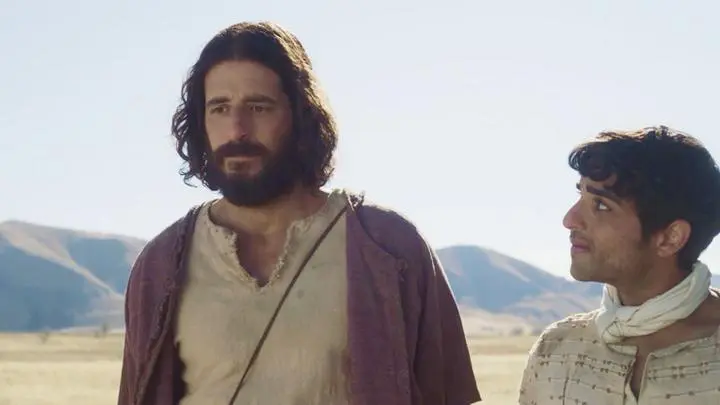
Summary of Episode 8
The episode opens with three men negotiating over a hillside property. The landowner is hesitant to sell land that has been in his family for 40 generations. The other two, including a younger man named Judas, press for a lower price by pretending they need it for burial plots. During the conversation, they realize the land hides a fortune in salt. They seal the deal, but Judas later struggles with guilt over the dishonest tactics. The older man brushes it off, implying that strategy and compromise are just part of doing business. Judas receives a generous advance, but doubt lingers.
Meanwhile, the Pharisees continue gathering evidence against Jesus. Tensions rise within their ranks, especially surrounding Nicodemus. Their accusations include Jesus healing on the Sabbath, forgiving sins, and associating with Gentiles and women.
At the disciples’ camp, preparations for Jesus’ upcoming sermon are underway. Some scout locations, others prepare supplies. But not everything is running smoothly; conflicts are emerging within the group as personalities and priorities clash under the pressure of growing expectations. Mary Magdalene helps Rama learn to read Psalm 139. Outside the camp, Jesus and Matthew work on the message. Jesus asks for Matthew’s honest feedback. When Matthew says it feels heavy, Jesus replies that he’s not looking for passive followers; he’s come not to start a rebellion, but to begin a revolution of the heart.
Despite growing opposition, Jesus’ influence continues to rise. The episode closes in slow motion as Jesus walks past the disciples and toward the crowd, preparing to deliver what is now known as the Sermon on the Mount.
Time for Personal Reflection and Summary
After the episode, invite participants to take a few moments of silence to reflect on what they’ve just experienced. Encourage them to think about what resonated with them, what caught them by surprise, or what was unclear. Next, invite them to think about the characters and consider whether they can identify with them or their situations. Encourage them to write down their thoughts or prepare them for a group discussion.
After a few moments of quiet reflection, invite the group to share the moments from the episode that stood out to them. You can use the “Episode Summary” to help you with this. Try to fill in the details you have noticed are missing from the summary. You can also use more creative methods to compose the summary.
Tip: For a more interactive way to summarize the episode, try using a mind map, The 5W1H Method, or other creative approaches. You can find these in the Leader Resources section online.
Some of the series’ concepts and themes may not be clear to all participants. A “Glossary of Terms” is provided to help with this.
Bible References
- Psalm 139:13-16
- Matthew 5:1-16
- Matthew 7:12
- 1 Timothy 4:8
Discussion
In the next section, you will facilitate the group discussion. You can use the questions in their entirety or select those relevant to your group.
What resonated most with you in this episode, and why?
In this episode, everyone is preparing for Jesus’ great sermon. Have you ever helped prepare for a big event such as a wedding, tournament, concert, or celebration? What was it like for you?
Each disciple prepared for Jesus’ sermon in a way that felt natural to them. What are some of your natural gifts or talents? How do you use them, or how would you like to use them?
Take a look at these three verses where Jesus talks about salt: Matthew 5:13, Mark 9:50, and Luke 14:34–35. What message do these verses carry? What common theme do these verses share? How are they different?
Jesus said the Sermon on the Mount is a call to revolution. What do you think he meant by that? What kind of change is he inviting people into?
Jesus clarifies that this revolution is not about revolt but about initiating a “radical shift” in people’s hearts and lives.
As Jesus begins to speak the Beatitudes, the scene shows people whose lives reflect those words. Which Beatitude do you most relate to, and why?
You can read the Beatitudes in Matthew 5:3–12.
Which Beatitude is the hardest for you to understand or live out? What challenges you about it?
In one scene, Judas says, “What I need is a life I can be proud of. Don’t you want to do something that will really matter…that will be remembered throughout history?” What would you want to be remembered for someday?
What was your first reaction when you realized Judas had entered the story? Were you surprised when his identity was revealed? How did the show’s portrayal shape your expectations of him?
If you had to describe Judas’ character based only on what we saw in this episode, how would you describe him? What details in his words, actions, or attitudes suggest that he might already be wrestling with internal conflict?
Matthew commented that Jesus’ sermon sounded like a list of difficult or negative statements. How did Jesus respond to that feedback? What does his reply reveal about the heart of the Sermon on the Mount, and what it means for those who want to follow him today?
Basic Questions
This first set of questions is straightforward and open-ended—great for seekers or those new to faith.
Advanced Questions
These questions are more in-depth and best suited for Christians and more mature participants. Use your discretion to select the ones that best fit your group.
Conclusion
At the close of the discussion time, take a moment to highlight the main ideas that came up during your conversation. The questions in this club meeting touched on the theme of "the Beatitudes."
You can read the quote from the episode below as a final reflection and encouragement. Invite participants to reflect on the message of this episode and consider how it might speak into their own lives.
KEY TAKEAWAY
“I don‘t want passive followers”
—Jesus
Afterward, you may want to allow a short moment of silence, prayer, or a smooth transition into the next activity.
Gospel Sharing Moment
As you lead discussions during this episode, keep in mind that the gospel message can naturally flow from your conversations. If the moment feels right, take the opportunity to share the Good News and invite participants to respond.
In Episode 8, Jesus teaches the Beatitudes—his blessings over the poor in spirit, the meek, and those hungry for righteousness These words reflect the heart of the Gospel: Jesus came for those who recognize their need for him. He offers hope to the weary, comfort to the broken, and purpose to the humble.
Consider sharing how these words have spoken to your own heart, perhaps in a time of grief, weakness, or longing for something more, and how Jesus met you in that moment. Personal stories help make his invitation feel authentic and reachable.
If someone wants to know more about what that means, you can turn to the section "Following Jesus: Your First Step" at the end of this guide. It explains how to begin a relationship with Christ and how to respond to his call.
Suggested Accompanying Activities
This can be at the beginning or the end of the meeting.
- Play an interactive game from the Group Activities section that focuses on the Beatitudes.
- During your gathering, write out all the Beatitudes on a large flip chart together as a group.
- Encourage participants to read the Sermon on the Mount at home (Matthew chapters 5–7). Invite them to choose one idea that speaks to them personally and express it creatively—through drawing, writing, or another form—and place it somewhere visible as a daily reminder.
- You can find suggestions for extra games and activities looking at the Group Activities Library on the Leader Resources page.
Glossary of Terms
The sprinkling of salt on Carthage
In a conversation with Jesus, Matthew references the destruction of Carthage by Rome after the Third Punic War (149–146 BC). Although later tradition claims that the Romans salted the land to prevent anything from growing, ancient sources do not confirm this detail, and it is likely a legend. Still, the image became a powerful symbol of total destruction and erasure from history. In the series, Matthew uses this powerful reference to highlight the seriousness of destruction, contrasting it with Jesus’ mission to bring renewal, restoration, and hope.

Salt
Salt was highly valued in biblical times, not only as a seasoning but especially as a preservative. In the hot climate of Palestine, preserving food was essential for survival. Salt was harvested from small pools near the Dead Sea or from ponds on the edge of the Syrian Desert, which dried up in summer, leaving behind a crust of salt.
The Beatitudes
The Beatitudes are declarations found in Matthew 5:3–12, in the section known as the Sermon on the Mount. They describe the blessings promised to certain groups of people or those facing specific life circumstances. These statements outline the qualities of those who belong to the Kingdom of God and affirm that they are truly “blessed.”
Following Jesus: Your First Step
Jesus welcomes each one with compassion. He doesn’t call the perfect, he calls the willing. He invites the weary, the searching, and the uncertain. Following him doesn’t erase your past, but it can redeem it. Jesus keeps calling, not because we’ve earned it, but because he loves us.
That same invitation is open to you today. The Bible gives us four simple truths about following Jesus. Click below to learn more.